EASY

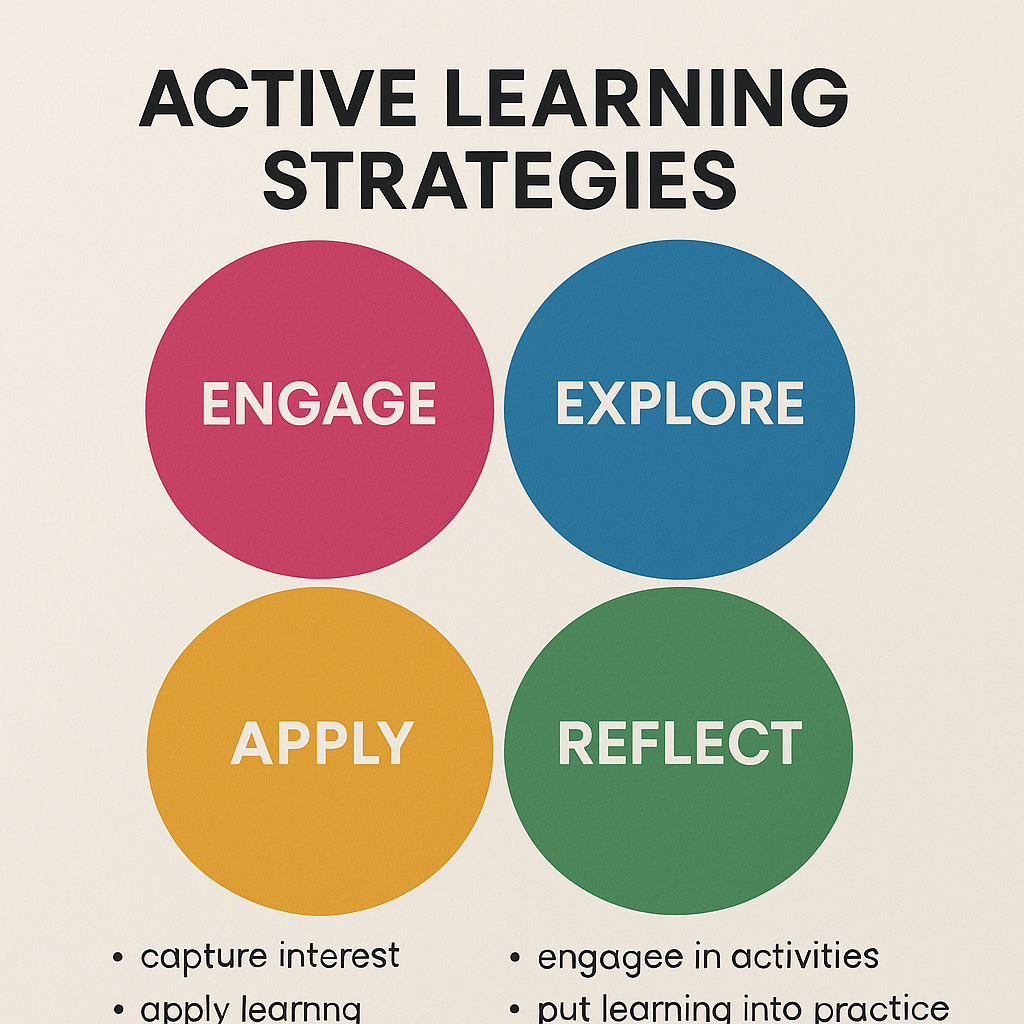
Module 2: Active Learning Strategies

Uncategorized
Wishlist Share
Share Course
Page Link
Share On Social Media

About Course

Active Learning Strategies turns learning from something you sit through into something you do. Instead of memorising and forgetting, in this approach learners question, test, practise, and reflect—alone and with others. This module is designed for young people from diverse backgrounds and for youth workers who want ready-to-use activities. It links classroom learning with real tasks, so participants build confidence and see progress quickly.

Europe’s labour market is changing fast with digital and green transitions. Employers value people who adapt, solve problems, and keep learning on the job. Active learning gives practical methods to do exactly that: break big goals into small steps, turn feedback into action, and transfer skills across subjects and settings. The approach also supports inclusion: varied tasks, simple language, and visual tools help different learners succeed.

Across three parts, the module blends short theory with hands-on activities, low-tech options, and reflection prompts that fit workshops or self-study. Youth workers will find clear instructions, timing guides, and alternatives for online/offline delivery. By the end, participants will know what active learning is, why it matters, and how to apply it in studies, volunteering, and work—so learning becomes a habit, not a one-off event. Practical, motivating, and easy to adapt and scale.

  • ACTIVE LEARNING STRATEGIES — What it is, why it matters, core habits and mindsets.
  • TOOLS & METHODS — Practical techniques (e.g., problem-based tasks, micro-projects, reflection journals, peer feedback).
  • APPLY & REFLECT — Real-life use in studies, youth work, and jobs; build a small portfolio.

Key Learning Objectives

  • Understand active learning and how it differs from passive study.
  • Practise concrete techniques to plan, try, get feedback, and improve.
  • Transfer strategies to real tasks in school, youth projects, and work.
  • Build confidence, inclusion, and teamwork through clear, low-tech activities.
  • Create a simple “learning plan” that can be reused and updated.
Show More

What Will You Learn?

  • -
  • - ACTIVE LEARNING STRATEGIES — What it is, why it matters, core habits and mindsets.
  • - TOOLS & METHODS — Practical techniques (e.g., problem-based tasks, micro-projects, reflection journals, peer feedback).
  • - APPLY & REFLECT — Real-life use in studies, youth work, and jobs; build a small portfolio.

Course Content

Part 1 — ACTIVE LEARNING BASICS
Active learning is about moving from being a passive listener to an active participant in your own learning. Instead of just receiving information, you question it, test it, and connect it with your own experiences. This approach helps you really understand and remember what you’ve learned. In workshops or school, it might mean working in groups, discussing ideas, or solving small challenges rather than just listening to a lecture. For young people, this skill is especially important: it builds confidence, encourages curiosity, and shows you that mistakes are part of the learning process. Employers across Europe value this mindset because it prepares you to adapt, solve problems, and keep learning on the job.

  • Part 1. ACTIVE LEARNING BASICS – Theory
    00:00
  • Part 1. ACTIVE LEARNING BASICS – Action

Part 2 — TOOLS AND METHODS
Strategies make active learning practical. These include simple tools like reflection journals, problem-based tasks, peer discussions, and micro-projects that connect theory to real-life challenges. For example, instead of only reading about sustainability, you might design a small project to reduce waste in your community and reflect on what worked. By using these methods, learners become more engaged and youth workers can make sessions more interactive and inclusive. These tools also help different types of learners—visual, practical, reflective—find their own way to understand and apply knowledge.

Part 3 — APPLY AND REFLECT
Learning only becomes powerful when you use it. In this final part, participants practise applying active learning strategies to real situations in school, volunteering, or work. Reflection is key: looking back on what worked, what didn’t, and how to improve next time. This builds a personal “learning cycle” that can be repeated with any skill, subject, or job task. For the EU labour market, this means being able to adapt to new technologies, teamwork demands, or green and digital transitions. For youth workers, it also means creating activities where participants not only do tasks but also share feedback and document their progress. This ensures the learning is long-lasting and transferable.

Student Ratings & Reviews

No Review Yet
No Review Yet
Gérer le consentement aux cookies

Afin d'offrir la meilleure expérience possible, nous utilisons des technologies telles que les cookies pour stocker et/ou accéder aux informations des appareils. Le fait de ne pas consentir ou de retirer son consentement peut avoir un effet négatif sur certaines caractéristiques et fonctions.

View more
Cookies settings
Accepter
Refuser
Confidentialité et cookies
Privacy & Cookies policy
Cookie name Active
PHPSESSID
Save settings
Cookies settings